TL;DR: If you're looking to hire a Webflow agency, there are five criteria to consider. Are they native to Webflow? Are they able to present live sites for actual results? Are they thinking SEO and speed from the get-go? Does the quote make it clear what you get? Will they help you once you're off the ground? If you can answer “yes” to all 5, then you have a good candidate.
How to choose a Webflow agency: 7 key pointers
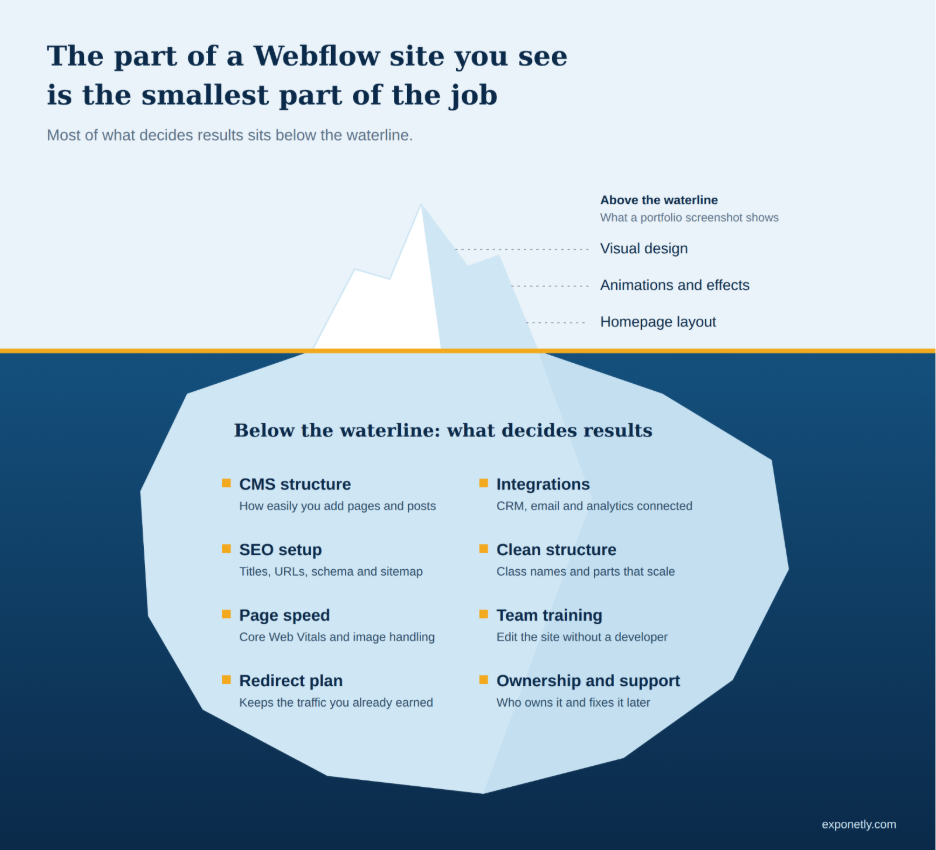
Choosing a Webflow agency is a bit like hiring a builder. Most of what matters is hidden once the job is done. You can't see how the pages are structured, how fast they load, or whether your team can edit anything without calling for help. You find out later, and by then you've paid.
This guide helps you find out sooner. It's written for founders and marketing leads at growing businesses, so you don't need to know Webflow. You'll get the questions worth asking, a straight look at cost, the warning signs, a scorecard and a checklist. Short on time? Read the pointers above, then jump to the checklist near the end.
Probably, if your website is a marketing tool. Webflow works well when you want a custom look, fast pages and a site your team can edit without code. That's why B2B companies, SaaS teams and service businesses lean on it.
It's not right for everything. Running a large online store with complex needs? Compare Shopify or WooCommerce first. Building a heavy web app? Webflow may not be the tool. A good agency will say so on the first call, even if it costs them the project. That alone tells you a lot about their honesty.
More than most people expect. A full-service team usually covers strategy, UI/UX design (often in Figma), Webflow development, CMS setup, SEO basics, tool integrations like HubSpot or Airtable, testing, launch and training. The CMS is the part that holds repeating content, like blog posts and case studies.
Some agencies only build what you hand them. Others only design. Neither is wrong. Just know which one you're hiring, so nothing falls into the gap between design and build.
A simple way to think about it: if your site drives revenue, and design, build and SEO need to work together, an agency is the safer bet. If the job is small, a freelancer may be plenty. Many growing businesses do both. The agency builds the site, then someone in-house handles the everyday edits.
Write a one-page brief first. It doesn't need to be fancy. Cover these points:
Agencies quote what they can see. A vague brief gets a vague quote, and vague quotes lead to surprise bills.
Ask yourself one thing: does this team build in Webflow every week, or did they add it to their services page last year?
Ask whether designs are built directly in Webflow or brought in from another tool. Native builds are cleaner, and they're easier for your team to edit later.
Webflow keeps a directory of partner agencies. Many agencies say the badge shows they were vetted for skill and project quality. That's a good sign, but it's not a guarantee. Look the agency up in the directory yourself, then judge the actual work.
A bit. An agency that has built SaaS sites already knows what a pricing page needs. But a strong process counts for more than a matching logo. Ask how they'd learn your market.
Ask to see something hard. Skip the polished homepage and look at CMS-heavy pages and forms. A messy CMS is painful to fix later, so a good agency plans collections, fields and names from day one. On the Bhat Group site, for a private investment and holding company, we built gated inquiry forms and a CMS that lets the team update holdings and portfolio status.
Screenshots are easy to make look good. Live sites and real results are much harder to fake.
Always ask for live links, then open them on your phone. Check how fast they load, how the layout holds up and whether the forms work. If an agency can't show you a live site, that tells you something.
Three things: the goal, what the agency did, and what changed. Numbers help, like traffic, leads or speed. Pretty images alone aren't proof.
Look at third-party sites like Clutch, and ask for a past client you can call. Then compare what the agency says with what clients say.
It's the one site they control completely. If it's slow or confusing, yours might be too.
Good agencies ask questions before they open a design tool. They want to know your goals, your users, your content and your limits. If your first call is mostly a sales pitch, notice that.
Beyond discovery, check four things: a timeline with real milestones, who actually works on your project (seniors or juniors), how feedback and revision rounds work, and how often you'll get updates.
Here's the thing about communication: how an agency treats you before the contract is usually how it treats you after. Slow replies now mean slow replies later.
It should be. SEO and speed belong in the build, not on a cleanup list after launch.
Ask what they set up: page titles, meta descriptions, heading structure, clean URLs, schema, a sitemap and image handling.
If you're replacing an existing site, ask about redirects. A strong agency brings this up before you do. Skip it, and you can lose traffic you spent years earning.
Core Web Vitals are Google's measures of page experience: loading, layout stability and interaction. Ask how the agency checks them before launch. Rich visuals and fast pages can live together, but only with care. For a book launch funnel we built, we tuned page speed to handle high traffic during the launch window.
Ask for a demo of the Webflow Editor. Your marketers should be able to change text, blog posts and images on their own. On that same book launch funnel, we set up CMS-driven sections so the author's team could change content and offers after launch.
Ask about class naming and reusable components. A messy structure makes every future change slower and more expensive.
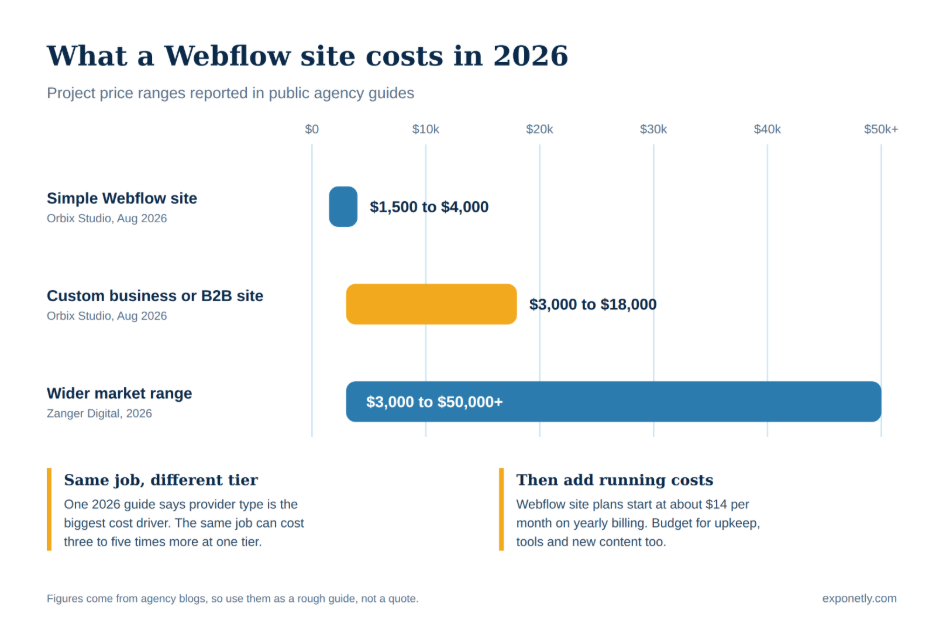
Public 2026 guides put it anywhere from about $1,500 for a simple site to $50,000 or more for a complex build. That's a huge gap, so let's look at what's behind it.
A word of clarity on those numbers. They come from agency blogs, and agencies have their own interests. Treat them as a rough guide, not a rule.
Mostly scope and who does the work: number of pages, design depth, CMS complexity, integrations, custom interactions, team seniority, location and timeline. One 2026 guide says the type of provider is the biggest driver, with the same job costing three to five times more at one agency tier than another.
Fixed price suits a clear scope. Hourly suits work that may change. A monthly retainer suits ongoing growth work and updates.
Because they often aren't quoting the same thing. One may include SEO setup and content structure. Another may leave them out. Compare what's included, not just the total.
A solid quote lists pages and templates, design rounds, CMS setup, integrations, SEO setup, testing, training, launch support, post-launch support, a revision limit and rates for extra work. If a quote skips several of these, ask why.
Webflow's own hosting and CMS plans are a separate cost. Site plans start at about $15 per month on yearly billing, or about $25 on monthly billing. The CMS plan is about $25 per month on yearly billing. Check Webflow's pricing page for current numbers. Also plan for maintenance, tools, new content and updates.
It can be. Offshore teams often cost less per day, and one guide says this works best for clear, well-planned builds. It also warns that a loose brief can wipe out the savings through extra revision rounds.
So don't just ask where they are. Ask whether their hours overlap with yours, whether they communicate clearly, whether senior people will work on your project, whether the contract spells out scope and ownership, and whether you can talk to past clients in your region.
Exponetly is based in Ahmedabad, India, and also has an office in London, UK. We work with clients around the world.
This is the part people forget to ask about, then regret. Before you sign, find out:
Get the ownership answer in writing.
A few things should slow you down fast:
Don't just listen to the answers. Listen to how they answer.
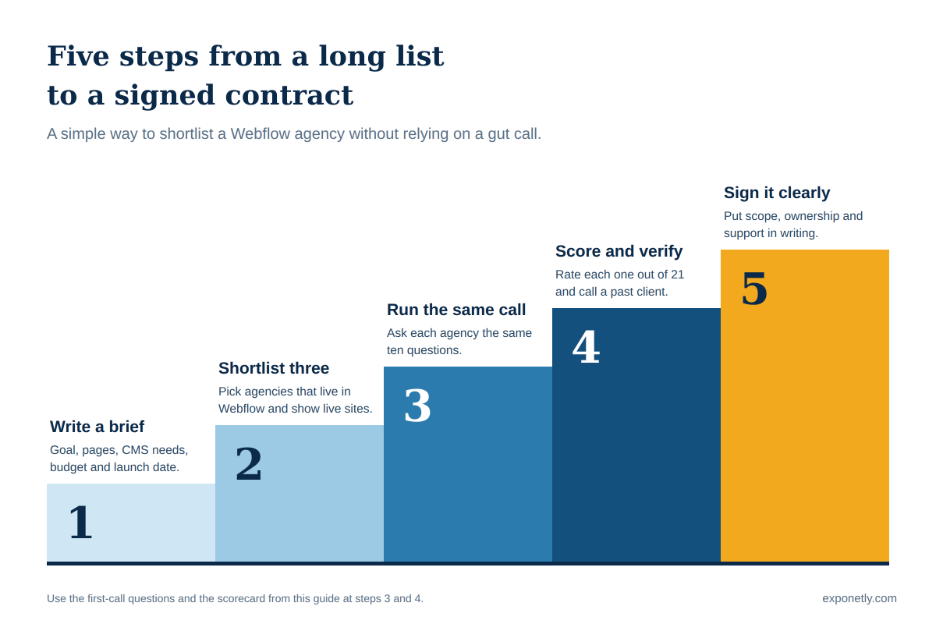
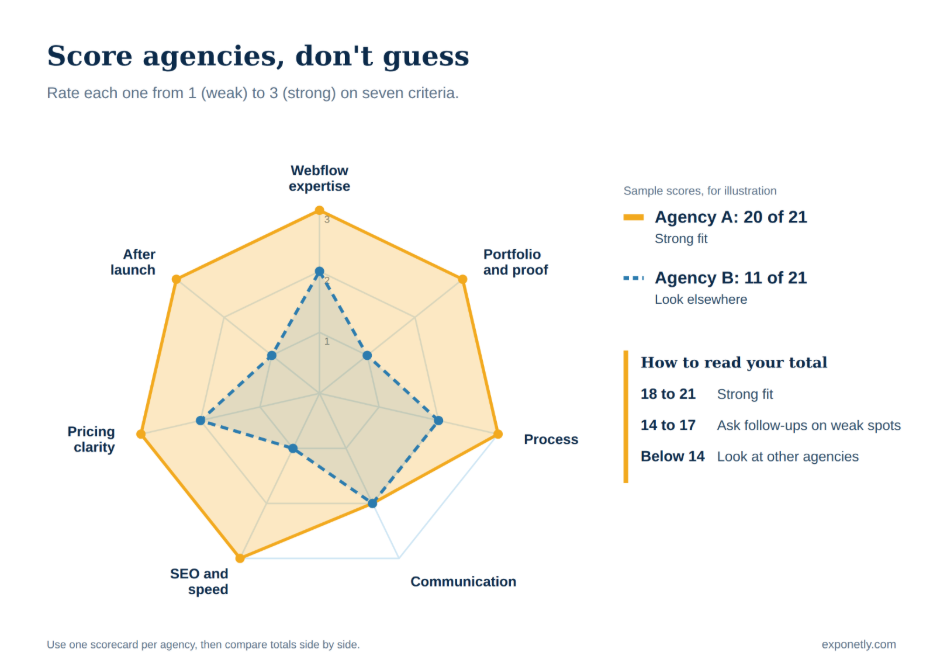
A gut feeling is fine, but a scorecard keeps you honest. Score each agency from 1 to 3 on seven criteria.
Add it up. A total of 18 to 21 (out of 21) is a strong fit. A score of 14 to 17 means you should ask follow-up questions on the weak spots. Below 14, look at other agencies.
A good proposal covers goals, scope, timeline, team, price, what isn't included, payment steps, support terms and ownership terms. Then the next steps are simple: shortlist three agencies, run the same call with each, score them, talk to a past client, and sign a clear contract with the one you trust.
Use this while you compare. Copy it or print it, and tick it off for each agency you talk to.
How to use your result: if an agency misses a few items in one group, ask follow-up questions. If it triggers any red flag, think twice before you move ahead.
Here's where we come in. Exponetly is a UI/UX design and development agency. We started in 2018 and build Webflow, Framer, WordPress and WooCommerce sites for business owners around the world. We're a Webflow Certified Partner, and one public DesignRush review calls our team responsive and strong on Webflow marketing funnels.
Ready to talk about your project? Tell us your goal, your pages and your timeline. We'll tell you honestly if Webflow is the right fit.
Choose the agency that proves its Webflow skill with live work, plans SEO and speed from the start, prices clearly and stands behind the site after launch. Score your shortlist, use the checklist, and go with the team you trust to grow with you.
How much does a Webflow website cost?
Many 2026 guides show about $3,000 to $18,000 for a custom business site. Simple sites cost less, and complex builds cost more. The final price depends on scope, team and location.
How long does a Webflow project take?
It depends on scope. A small marketing site moves faster than a large site with a big CMS and integrations. Ask for a timeline with milestones before you sign.
Is Webflow good for SEO?
Yes, when it's built well. Webflow gives you control over page titles, meta descriptions, URLs, redirects and schema. Results still depend on the setup and your content.
Is an agency better than a freelancer?
For full builds that need design, development and SEO together, an agency is usually safer. For small jobs, a freelancer can be enough.
Can I update the site myself?
Yes. Webflow's Editor lets your team change text, images and blog posts without code. Ask the agency to train your team.
What if I want to switch agencies later?
Ask about ownership before you sign. Webflow lets agencies and freelancers hand a site over to a client's Workspace, and some plan rules apply. Confirm the handoff steps in your contract.