TL;DR - In 2026, most professional website redesigns cost between $3,000 and $70,000. Simple refreshes can come in lower, while ecommerce, custom, and enterprise projects often pass $100,000.
If you have ever opened a redesign quote and felt your stomach drop, you are not alone. Website pricing can feel like a maze, and nobody wants to waste money on a project they do not fully understand.
Where your project lands depends on your goals, the size of your site, your platform, how much content needs work, how carefully your SEO is protected, and what has to connect to what. This guide walks through realistic numbers in plain language, so you can plan with confidence and keep surprise bills out of the picture.
A website redesign is the work of improving how your site looks, how it functions, and how well it turns visitors into enquiries or customers. That might mean fresh layouts, clearer navigation, sharper copy, faster pages, or a smoother path from first click to first conversation.
Think of your website as a first handshake. Buyers form an opinion within seconds, and a slow, dated, or confusing site can quietly send them to a competitor before you even know they visited. That is a painful thing to discover after months of marketing effort.
A redesign also makes life easier for your own team. A well-structured site lets you publish new pages without a struggle, and it gives your SEO, AI search visibility, lead generation, and long-term growth a solid base to stand on.
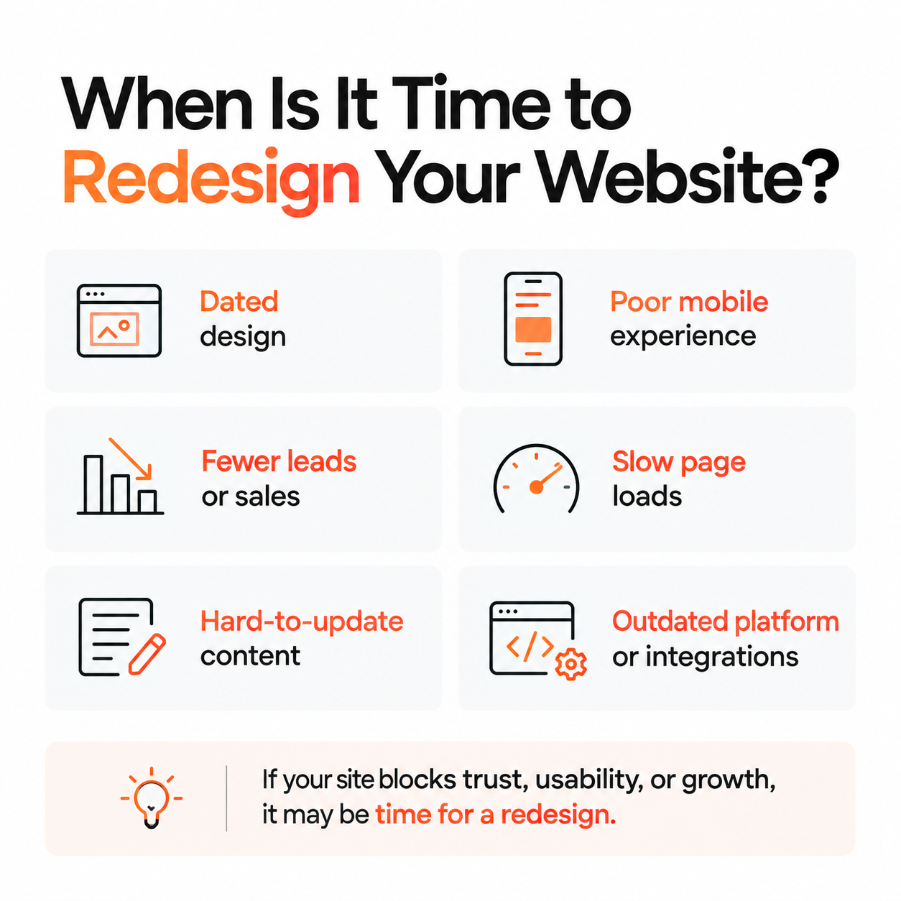
Redesign when your website has stopped helping you reach your business goals. The most common warning signs are a poor mobile experience, falling conversions, outdated branding, and content that is hard to update.
A slow site, a confusing layout, or pages that look different on every device all chip away at trust. They also make it harder for the people you most want to hear from to take the next step. Watch for these signals:
If the structure underneath still works, a lighter refresh may be all you need. A full redesign makes sense when design, user experience, content, and business goals all need attention at the same time.
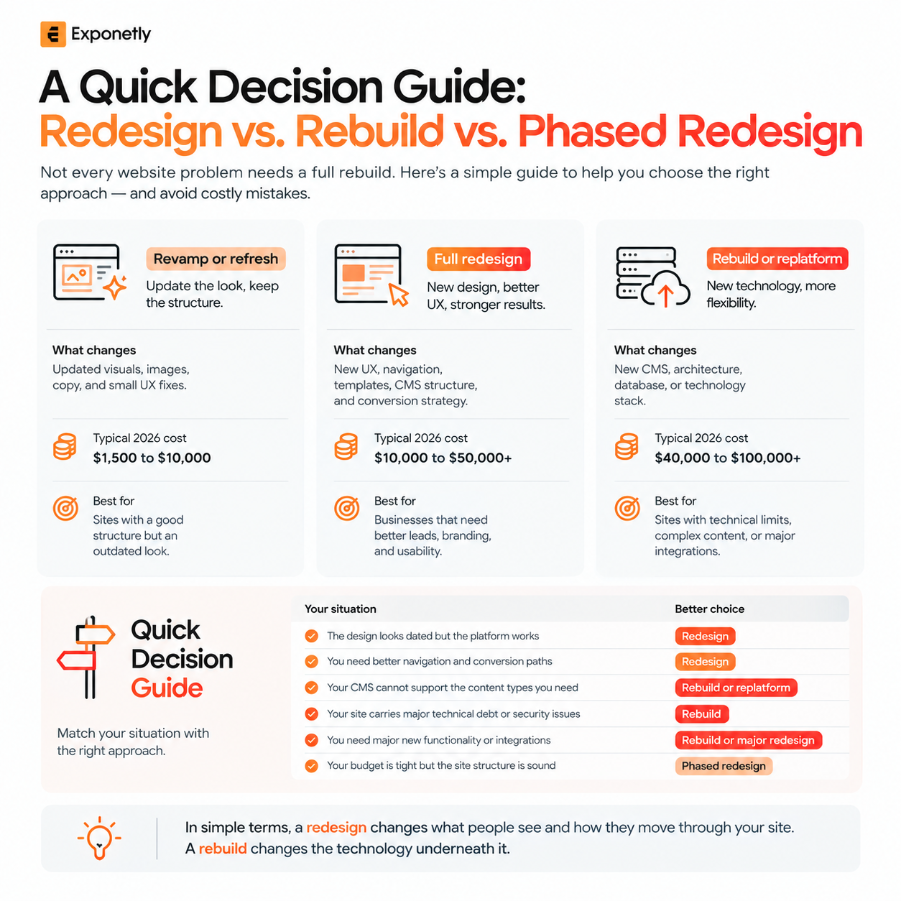
Before you ask for quotes, work out which kind of project you actually need. Not every website problem calls for starting from scratch, and choosing wrong can cost you thousands.
Choose a refresh when your site performs well but looks tired. Choose a redesign when the user experience, branding, and conversion paths need real improvement. Choose a rebuild when your current platform cannot support your content, integrations, ecommerce needs, or future growth. Rebuilds cost more because strategy, migration, development, and testing all come into play.
In simple terms, a redesign changes what people see and how they move through your site. A rebuild changes the technology underneath it.
Most professional website redesigns land between $3,000 and $50,000. Small business projects usually sit at the lower end, while ecommerce and enterprise projects cost more because there is simply more to plan, build, and test.
A basic redesign suits a small service business with a simple site. A medium redesign fits a growing business that needs better structure, stronger SEO, and more leads.
An advanced redesign is built for ecommerce stores, SaaS companies, healthcare providers, and larger enterprises. These projects need deeper planning, more development and testing, and usually ongoing support after launch.
Pricing makes more sense when you think in levels. Each one brings a different mix of strategy, design, development, and support, and each comes with its own trade-off.
Level 1 is the gentlest on your wallet, but it asks for your time and your design judgment. The hours add up quickly once you need custom features, SEO work, or complex integrations.
Level 2 works well when the scope is clear and you are comfortable steering strategy yourself. Just confirm that your freelancer can handle mobile responsiveness, SEO basics, performance, and post-launch support.
Level 3 is often the sweet spot for growing businesses. You get professional strategy, design, development, and SEO support without enterprise-level complexity. With an agency, the higher price buys one accountable team, specialist skills, and fewer painful handoffs.
Level 4 is the right call when your website is a core revenue channel, or when you need custom functionality, complex integrations, or large-scale content management. Whichever level you consider, try not to decide on price alone.
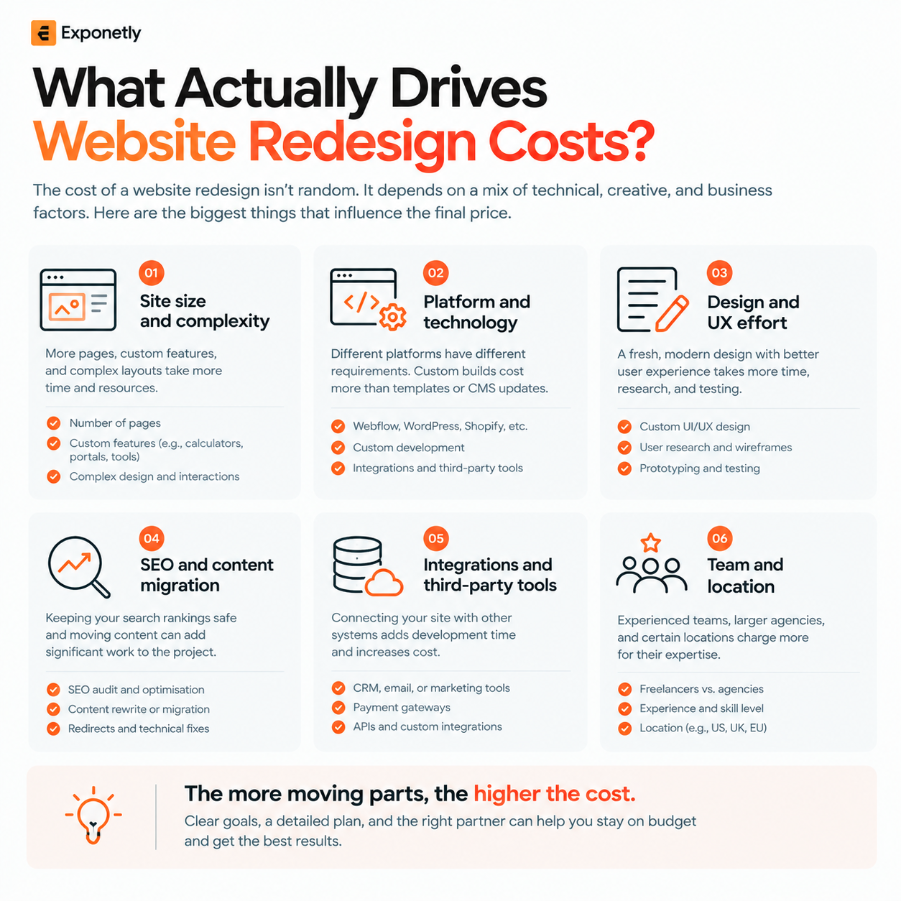
Scope drives cost far more than page count. Two websites with the same number of pages can end up with very different budgets, and that surprises many first-time buyers.
Unique page templates are usually the biggest driver. A 30-page website built on five templates can cost less than a 15-page website with ten custom layouts.
Content migration is another common surprise. Moving blogs, case studies, products, images, and downloads takes real time, especially when old content needs cleaning up first.
Your platform shapes design flexibility, development time, monthly costs, and future maintenance. Pick it for what your business needs, not for what is trending this year.
WordPress is often cost-effective for content-heavy sites. Keep in mind that plugin conflicts, security updates, and custom development can raise long-term costs.
Shopify is strong for ecommerce, yet complex catalogs, custom checkout flows, and app integrations can stretch the budget. A fully custom platform only makes sense when standard tools truly cannot meet your requirements.
Because it touches the entire buying journey. You are not just making things look better. You are reshaping how shoppers find products, check out, and how your team manages orders.
A serious ecommerce redesign commonly costs $40,000 to $150,000 or more. Simpler Shopify-based redesigns can cost less, but large catalogs and custom functionality push the budget up. Typical cost items include:
Ecommerce SEO migration deserves special care. Losing product-page rankings can hit sales directly, so redirect mapping and metadata preservation should be planned well before launch day.
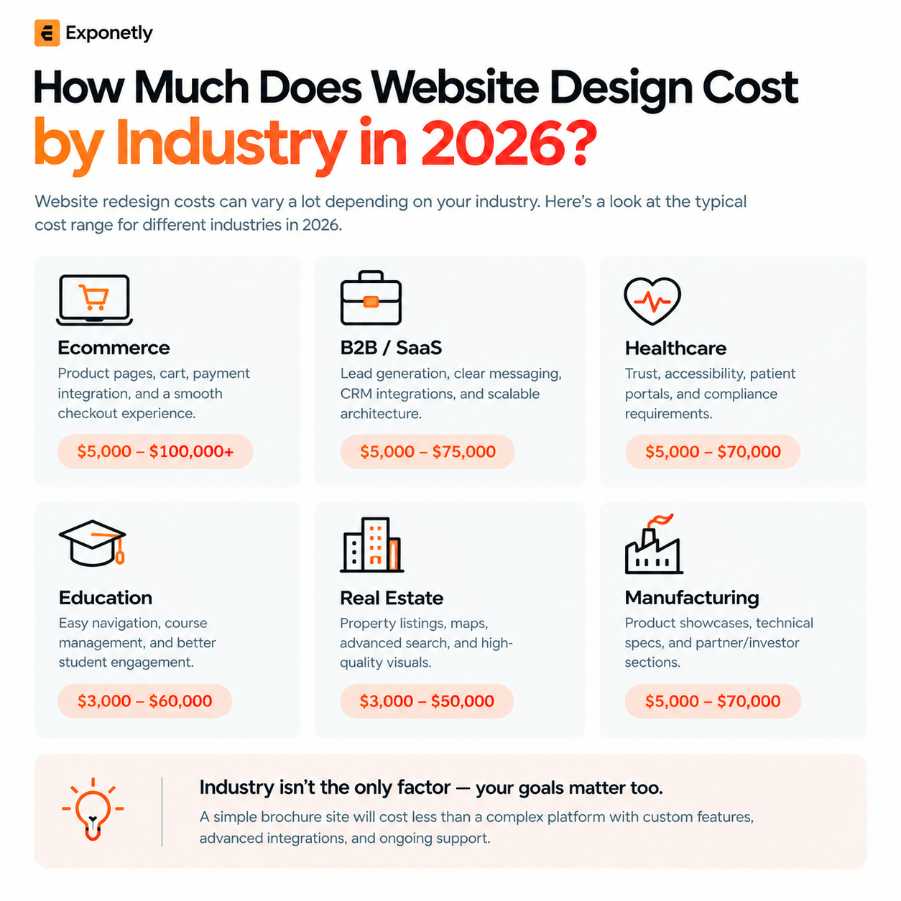
Industry matters because compliance rules, functionality, and customer journeys differ. Treat these ranges as planning guides, not fixed quotes.
A local plumber may only need a clean, simple lead-generation site. A hospital, a bank, or a SaaS company carries far more compliance, security, integration, and testing demands.
"AI website redesign" can mean three very different things, and the price shifts depending on whether you use AI tools yourself, an AI site builder, or an agency that uses AI to work faster.
AI can cut the time spent on wireframes, copy drafts, image creation, and basic development. What it cannot do is replace brand strategy, SEO migration, accessibility testing, or conversion optimization.
Use AI to speed up production, never to skip planning. A beautiful AI-generated site can still disappoint you if it does not rank, load quickly, or convince visitors to act.
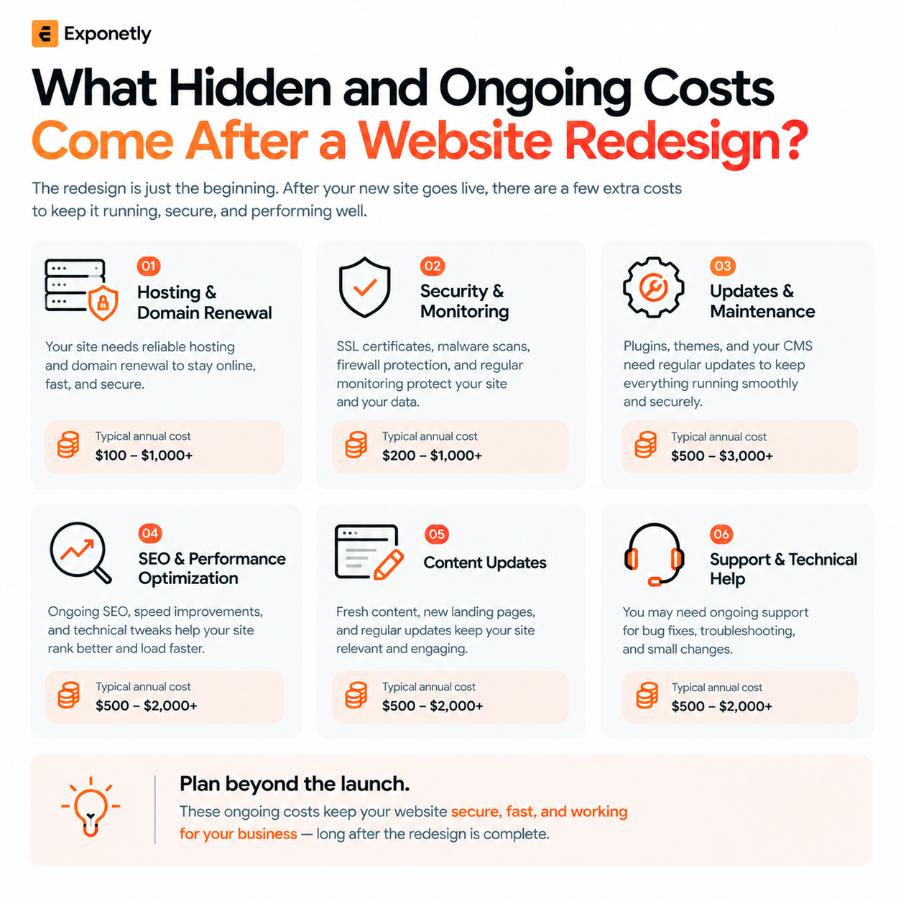
Many businesses budget only for design and development, then feel blindsided by everything else. Copywriting, migration, SEO, software, training, and post-launch improvements all need room in your plan.
Always ask for an itemized quote before you sign. A suspiciously low number may leave out the very work your project needs most.
Cut scope, not quality. Put your energy first into the pages and features that directly affect leads, sales, and customer trust.
A phased approach is especially kind to growing businesses. Launch the core site first, then improve secondary pages, integrations, and advanced features as budget and confidence grow.
A good quote tells you what is included, what is not, and what could change the price. Ask these questions before you hire anyone:
Get the answers in writing. It protects your budget and makes agency proposals far easier to compare side by side.
A professional redesign follows a clear path. Skipping discovery or SEO planning is the shortcut that most often turns into an expensive, stressful problem later.
Please do not treat launch day as the finish line. The first 30 to 90 days are when you catch issues, watch your SEO, and fine-tune the paths that turn visitors into customers.
It is worth it when it improves leads, sales, customer trust, or the efficiency of your team. Do not judge the value by looks alone. A good-looking site that does not move your numbers is just an expensive brochure.
Here is a simple formula to keep handy:
Potential annual value = Additional leads or sales × Average customer value
Take an illustrative example. If a redesign brings in 20 extra customers a year and each one is worth $2,500, the potential annual value is $50,000. A $30,000 redesign could then pay for itself within the first year.
The best budget is not the cheapest quote. It is the investment that solves your real business problem without creating SEO, usability, or maintenance headaches down the road.
If these numbers have you wondering who can handle your project without the stress, we understand. We’re Exponetly, an official Webflow Certified Partner and Framer Official Expert. Since 2018, we’ve been designing and building websites for startups, service businesses, SaaS companies, and global brands. Our clients rate us 4.9 out of 5 on our website.
Here’s what working with us costs:
These are starting prices. Copywriting and custom photography are not listed as package inclusions, so please ask about them on your first call. Ready to talk numbers? Book a 1:1 call, see our full pricing, or browse our portfolio.
How much does a professional website redesign cost in 2026?
Most professional redesigns cost between $3,000 and $50,000. Basic projects can cost less, while ecommerce, custom, and enterprise projects can go beyond $100,000.
What is the average cost of a small business website redesign?
A small business redesign usually costs between $3,000 and $30,000. The final price depends on page count, custom design, content migration, SEO, and integrations.
What is the difference between a website refresh, redesign, and rebuild?
A refresh updates visuals and small UX details. A redesign reworks UX, templates, navigation, and conversion strategy. A rebuild replaces the platform or technical architecture.
How much does an ecommerce website redesign cost?
A serious ecommerce redesign often runs from $40,000 to $150,000 or more. Product migration, checkout, integrations, and SEO protection drive the higher price.
Does a website redesign include SEO?
Not always. Many quotes leave out SEO migration, redirect mapping, metadata updates, and post-launch monitoring, so confirm this before you sign anything.
Will redesigning my website hurt my Google rankings?
It can, if URLs, content, metadata, or internal links are handled carelessly. A proper SEO migration plan greatly lowers that risk.
How much does a freelancer charge for a website redesign?
Freelancers often charge $1,500 to $10,000 for a small or clearly defined redesign. Complex projects may need an agency or a larger team.
How much does an AI website redesign cost?
DIY AI tools may cost $20 to $200 per month. AI-assisted professional redesigns still need budget for strategy, SEO, development, and QA.
What hidden costs should I budget for after a redesign?
Plan for copywriting, imagery, SEO migration, integrations, hosting, maintenance, training, and post-launch conversion optimization.
How long does a professional website redesign take?
A simple redesign may take 4 to 8 weeks. A custom, ecommerce, or enterprise project can take 3 to 6 months or longer, depending on scope and how quickly approvals come in.